



Growing trendier and trendier among expats in recent years, the stunning Portuguese city of Lisbon is a fantastic destination to consider when planning your next international move.
Just like Rome, Lisbon is said to have been built on seven hills—and living in Lisbon is certainly famed for its daily backdrop of breathtaking panoramic views.
Speaking of Rome, one thing many don’t know is that Lisbon is actually the second oldest city in Europe, predating Italy’s ancient capital by hundreds of years!
Let’s dive into the glorious details of this colorful, welcoming, and richly historic would-be home as we explore Lisbon for expats!
Lisbon sits nestled against the Atlantic Ocean, about two-thirds of the way down Portugal’s Western coastline. The city also warmly hugs the vast mouth of the River Tagus, so all who love waterfront cafés and bars are in luck!
Lisbon has a long and fascinating history as a seaport, has withstood many invasions over the centuries, and even a huge Earthquake in 1755—so its culture is forged from resilience!
As Portugal’s capital, Lisbon is the country’s largest, most multicultural, and wealthiest destination. Living in Lisbon means joining a population of around 500,000 in the old city and closer to 3 million in the larger metropolitan area.
1. Is Lisbon a good place to live?
Lisbon is a fantastically welcoming city, bursting with diverse cultural influences and a dizzying array of phenomenal architecture, art, and entertainment.

It is a student city, as well as being visited by countless tourists every year, so the city’s population shifts—making it great for people watching and making new friends from all over the world.
That said, there are so many beautiful neighborhoods to choose from, and if you want to steer clear of the tourist trail or pick a family-friendly spot that doesn’t get too noisy at night, that won’t be a problem.
2. Is the climate good in Lisbon?
The climate in Lisbon can be considered semi-Mediterranean, in the sense that the city isn’t subject to the overwhelming summer heat that can be the norm even a little further inland!
While the sunny season is long and the winter very short, Lisbon enjoys low humidity thanks to the Atlantic breeze, creating a very enjoyable warm weather climate.
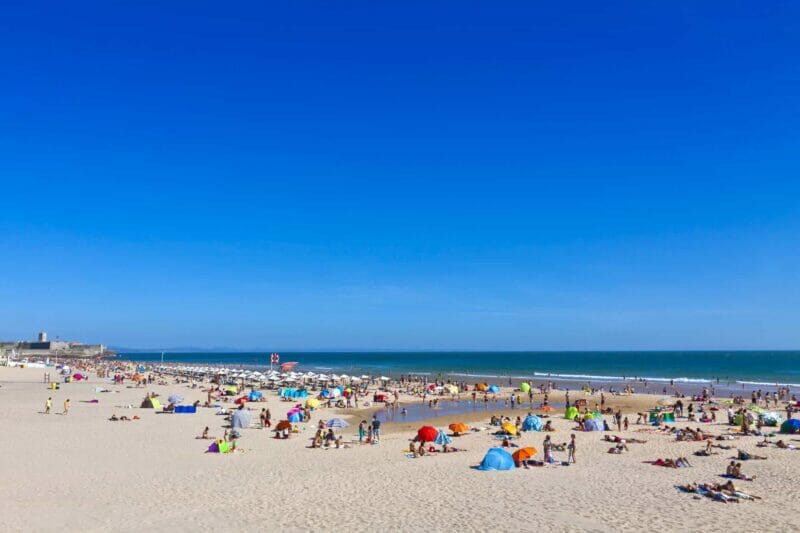
This is, of course, the perfect complement to the city’s laid-back lifestyle and all the beaches nearby!
The city is also not subject to the freezing temperatures of, say, Porto—although it is important to remember that it does get cold and wet for a while mid-winter! Anticipate usual summer heatwaves in the high 30ºCs range, or 90º-100ºF, and lows in the winter of around 8ºC or 45ºF.
3. Is it easy to travel to and around Lisbon?
Lisbon’s public transport is abundant, with metro lines lacing the city, tram cars, and buses zipping about.
The airport is directly accessible via the metro, and only a ten-minute ride from the city center, making living in Lisbon ideal for retirees who want their families to be able to visit with ease.

4. Is Lisbon a walkable city?
Lisbon is a very walkable city. However, as we mentioned already, Lisbon gets pretty hilly.
Some of the older parts of the city can be very steep and narrow, but for retirees—or those who simply don’t want a workout when walking around—there are several elegant and flat neighborhoods to choose from!
Right across the city, the pavements are made of gorgeous old cobbles that are polished by the thousands of feet that pass over them.
For expats in Lisbon, it is absolutely crucial to stick with non-slip shoes and perhaps leave those stilettos at home!
5. Is living in Lisbon expensive?
Living in Lisbon is a little more expensive than living in other Portuguese cities like Porto or Coimbra but still far cheaper than other European destinations like Paris or Madrid.

That said, by being selective about location and getting off the beaten trail when looking for grocery stores and eateries, you can certainly get more from your monthly budget.
How expensive is property in Lisbon?
Properties in Lisbon tend to run at around 1.5x the price of similar accommodation in Porto, although there are bargains to be found!
Rental prices begin at around 800€ for a studio apartment in a central location, with 1000€-2000€ per month perfectly realistic for a fully modernized family home.
Competition can be stiff for rentals because so many of the city’s top locations have filled up with Airbnb properties. Be prepared to move quickly, and anticipate that landlords may ask for a larger deposit from a newly arrived expat in Lisbon.
In terms of properties to buy, a small studio or one-bed apartment can be picked up for as little as 100,000€, while a family-sized home may range between 200,000€-500,000€, depending on modernity and location.
Of course, Lisbon is also bulging with luxury properties, spanning into multi-million Euro budgets. The good news about this scale is that the right property is bound to be out there for just about everyone!
- How To Buy A Property In Portugal – a foreign buyer’s guide to a safe property purchase in Portugal.
Is public transport expensive in Lisbon?
Local transport is very inexpensive, with bus and metro trips starting from just a few Euros and monthly passes for senior retirees starting at only 20€ per month.
Is dining out affordable?
Dining out in the tourist-centric spots in Lisbon’s Baixa (downtown) area can get pretty costly, but only a quick meander away from those obvious eateries will reveal far more affordable options.
Discover some of the best espressos in the world for as little as 60 or 70 cents in street-side cafés, and wining and dining in Tascas, or traditional Portuguese restaurants, from as little as 15-20€ per head.
If you want lunch on the go, grab a Bifana (marinated pork sandwich) for around 5€. Lisbon is famed for its seafood, so don’t hesitate to tuck into a Cataplana de Marisco for an authentic local dining experience!
6. Do I need a car in Lisbon?
For those dreaming of a home within Lisbon’s narrow balcony-lined historic streets, it’s important to keep in mind that parking can be a nightmare!

If this is the type of living in Lisbon experience that you crave, then consider skipping car ownership altogether and simply hire a car when you fancy a road trip.
Lisbon’s drivers can also be quite aggressive, so if you do want to keep a car, be sure to also keep your wits about you!
7. Is it safe to live in Lisbon?
According to the Global Peace Index of 2020, Portugal is the safest country in Europe, and internationally, it even ranks higher than Japan!
As the capital, Lisbon does see a slightly higher crime rate—as you would expect in any larger urban environment—but it is still a very safe and peaceful place to be.
With millions of tourists arriving in Lisbon every year, much of the city’s crime is targeted at visitors in the form of petty theft and pickpocketing. This makes keeping an eye on your purse and valuables part of a savvy approach to personal security.
When wandering the vibrant Bairro Alto area—a major top spot for nightlife—don’t be thrown by enthusiastic approaches from pushy hash sellers. They will approach anyone who doesn’t look Portuguese but happily, will quickly take no for an answer!
8. Do I need to know the language to live in Lisbon?
Many expats, from retirees to digital nomads, enjoy that English is spoken much more widely in Lisbon than in other Portuguese locations.
However, getting busy with learning some of the lingo is a great way to integrate into your new neighborhood and get a little more immersed in the relaxed Portuguese pace of life!
9. What are the pros and cons of living in Lisbon?
If you are considering whether living in Lisbon is right for you, wouldn’t a pros and cons list be handy? Well, we’ve got you covered! Here are some immediate pros and cons to weigh up:

The pros
Lisbon is a warm and welcoming multi-cultural city, with English commonly spoken.
The city is loaded with extraordinary architecture and endless panoramic views. If you want to get lost exploring and get immersed in history, Lisbon is a great choice!
Lisbon is a gourmand’s paradise, with spectacular Portuguese cuisine as well as international menus to be found on almost every corner.
The Portuguese capital enjoys fantastic weather across the majority of the year, as well as easy access to beautiful beaches.
Public transport is readily available, with multiple options and a convenient airport connection.
Whenever big-name music acts or art exhibitions tour Europe, Lisbon is usually on their schedule. For those who love cinema know that movies are almost always subtitled rather than dubbed, so Hollywood blockbusters remain in English!
Lisbon offers a great choice of state and private schools, including international options.
The city also offers great shopping, from high-end boutiques to “feira da ladra” flea markets.
Beyond the treasures of the city itself, there are countless day-trip options close by, including Sintra and Cascais!
The cons
Yes, there are a few cons to living in Lisbon, but hopefully not too many to scare you off.

Keeping a car in Lisbon’s older central areas can be a challenge due to narrow streets and limited parking.
Lisbon’s more historic properties can be draft and cold in the winter and not very soundproof. Consider all seasons and who your neighbors might be when viewing properties!
Lisbon is primarily a city of apartment homes. Private homes with gardens are a little trickier to come by, and competition for rentals can be tough.
Job opportunities in Portugal are limited, and salaries tend to be low, with the minimum wage sitting at only 660€ per month. That said, the city is home to many startups and tech companies. Finding well-paid work here requires some smarts and a top-notch CV!
Portugal is renowned for its bureaucracy, and living in Lisbon is no different! Prepare to queue, wait, and chase to get things done—and even then, paperwork always takes a while. Be like the Portuguese, and remember that if it doesn’t happen today, it’ll happen “amanha”!
10. Where should I live in Lisbon?
The word for a neighborhood in Portuguese is “bairro”. So, which are the best to explore when aiming toward living in Lisbon?
Lisbon’s best neighborhoods
Well, if you want to be right on the pulse of the daytime buzz, then Baixa, Rossio, and Restauradores are certainly the places to be. If you are instead a dancing king or queen, Bairro Alto, Bica, and Cais do Sodré are the nightlife-loaded locations to scout!

If you are a retiree dreaming of an elegant Lisbon home in a flatter part of the city, the sophisticated Saldanha will likely suit you well. A slightly more expensive neighborhood, Saldanha attracts professionals and retirees alike thanks to its refined aesthetic, wide sidewalks, brilliant amenities, and metro line connections.
Similarly, for retirees—and equally for families looking for a new home-from-home—nearby Aroios offers flat terrain and a pleasing ambiance, with metro connections and trendy social spots, for slightly lower price tags.
Another fantastic and flat family location is Campo de Ourique, which is located just north of Estrela and is often described as a “city within a city” because everything you need is on your doorstep!
For those hoping to get a hit of history every time they open their front door, Lapa is a hilly neighborhood packed with stunning tile-fronted historic homes.
If you’d like to enjoy the view but from within a modern home, Príncipe Real provides a fashionable and contemporary option.
Bonus tips: how to be like a local
Whenever scoping out an area in Lisbon, don’t forget to take transport into account. The whole city is not equally served by the metro lines, and not all areas are ideal for keeping a car.
Because most homes are apartments, it is vital to think about your daily lifestyle. Will you be happy heaving shopping up a steep winding staircase, or would it be better to look for a building with an elevator?

On a siesta schedule, most businesses shut for lunch, so this is not the time to run errands! When heading out for dinner, don’t hope to be served before 7 pm, and know that bars and nightclubs won’t start to fill until around 11 pm.
Lisbon is steep, with perilously polished pavements! Choose practical footwear, and consider a flatter neighborhood if becoming a retiree expat in Lisbon.
Older Portuguese homes are sometimes poorly insulated and equally poorly soundproofed. Keep this in mind when viewing properties, and invest in insulation if taking on your own renovation project!
Lisbon is a football-mad city! The capital is divided by love for two rival teams: red-shirted Benfica and green-shirted Sporting. The football culture is friendly but also sacred, so discuss the two teams with diplomacy!
If you need a powerful espresso fix in Lisbon, ask for a “bica”. This commonly used name is an acronym, standing for “beba isso com açúcar”, which literally means drink this with sugar!
If you’d rather have a shot of the city’s famed liquor, head to one of the city’s many hole-in-the-wall bars and order a “ginjinha”. If you’re lucky, the rich cherry liquor will be served in a chocolate shot glass!
Final thoughts on living in Lisbon
If you are considering moving to Portugal, could Lisbon be the ultimate expat destination on your list?
Undoubtedly, living in Lisbon comes with all of the joys of being in a vibrant and international hub, alongside the bounties of abundant history and a calm pace of daily living.
Living in Lisbon should definitely be on the radar of retirees, families looking for a fresh start, and anyone hoping to maximize the rewards of a successful remote working career.
The city allows you to experience endless entertainment and cultural options, buzzing nightlife, beautiful weather, and gourmet eating at impressive prices. You can head to the beach on a sunny afternoon or stroll through the Mercado de Campo de Ourique to buy your fresh groceries.
For anyone aspiring to an authentic European city experience, there could hardly be a better choice!
Other popular locations in Portugal to consider:
- Living In Setúbal
- Retiring To Madeira
- Living in Viseu
- Living in Cascais
- Living In Sintra
- Living In The Azores
You might find useful:
- Living in Portugal As An Expat – The Absolute Relocation Guide: practical information and tips on moving to Portugal from the pros and cons to visas and residency, the cost of living, taxes, and more.
- Best Places To Live In Portugal – a detailed overview of the most popular expat locations.
- Didn’t find what you were looking for or need further advice? Comment with your question below, and we will do our best to help.












I really enjoyed reading this article. I have been considering visit beautiful Portugal for a very long time and a possible relocation. Is there a way to meet up with expats when I visit. Looking forward to hearing from you. Again, thank you for the fantastic information.
Hi Francine, there’s a FB group called Expats in Lisbon, you could ask to join, chat with people and maybe even organise a face-to-face meeting?
Good luck with your trip.